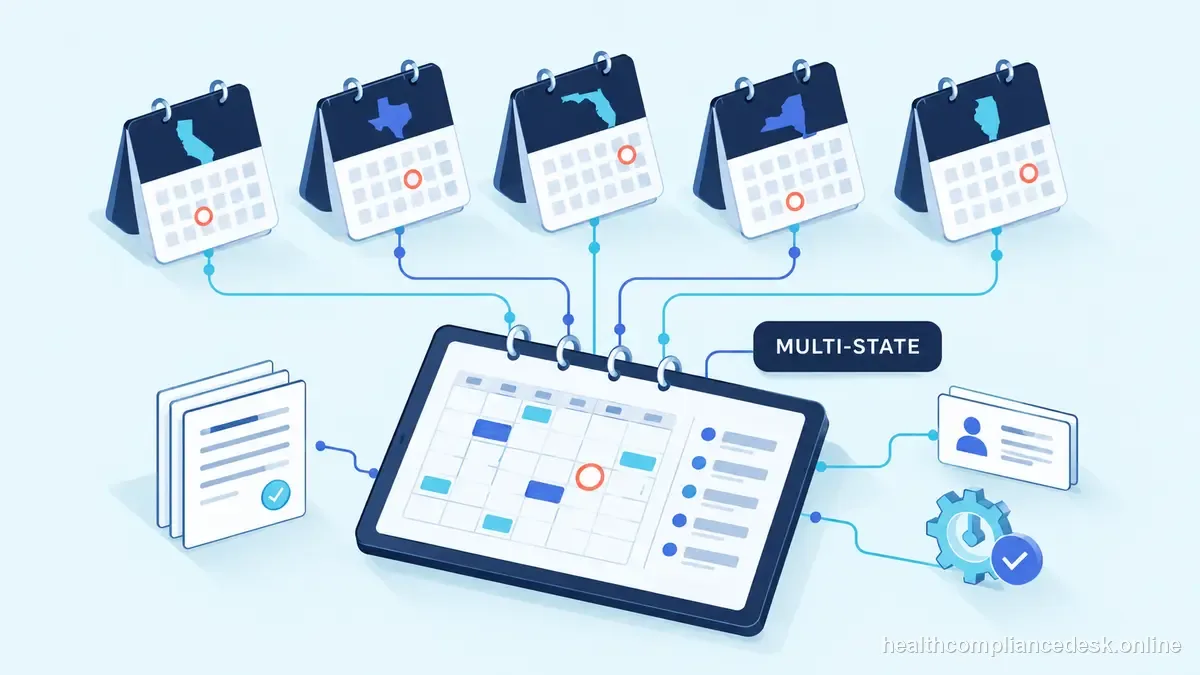
Build an Insurance License Renewal Calendar That Survives Multi-State Growth is easy to misread as clerical work, but problems usually begin when acting on the wrong status. The analysis here separates the records, decision points, and evidence that let insurance producers and licensing administrators determine which status is established and which is unresolved.
Scenario for multistate renewal calendar
In a license renewal calendar review, a producer holds several authorities and assumes each one needs a separate block of classes. When handling license renewal calendar, in this CE issue, first determine whether the resident state applies one general CE pool across those authorities and then identify any specialty training that remains separate. For the license renewal calendar file, that check can prevent duplicate coursework without creating a deficiency.
If the deadline already passed for this scenario
A multi-state calendar should track resident status, license expiration, CE completion, transcript confirmation, and filing confirmation as separate dates. When handling license renewal calendar, a late certificate can prove when education was completed, but it does not determine the legal effect of lateness. Read the state’s reinstatement or deficiency instructions, document any fine or additional step, and confirm when the licensee may resume activity if the license was affected.
keep proof beyond the renewal receipt
Preserve the state source checked, CE transcript, course approval information, completion certificate, renewal submission receipt, payment confirmation, and final license status. In a license renewal calendar review, if a provider had to correct a roster, save that correspondence too. These records explain both what the license holder completed and what the regulator accepted.
Build the next-cycle control
For this license renewal calendar issue, track CE as due, scheduled, completed, posted, and reconciled. For this license renewal calendar issue, those stages expose where work is stuck; a single “complete” checkbox cannot distinguish a finished course from accepted state credit.
Start with four dates, not one before the next step
Work backward from the state deadline and leave operational buffer for course-provider reporting and corrections. The internal target can be earlier than the legal deadline, but label it clearly so staff do not confuse an agency control date with a statutory cutoff.
- DueConfirm resident state, license type, lines, and cycle.
- ScheduledChoose a course tied to the actual deficiency.
- CompletedKeep certificate and provider reporting evidence.
- PostedReconcile accepted transcript.
- FiledSave receipt and confirm final license status.
Work backward from the filing window in the working file
Build the renewal task from the regulator record: identify the missing CE, select approved education, complete it early enough for reporting, reconcile the transcript, then file renewal through the accepted channel. When handling license renewal calendar, capture the filing receipt and confirm that the license returns to the intended active status.
Transcript lag is a separate risk
When handling license renewal calendar, online, webinar, classroom, and self-study labels are meaningful only to the extent the jurisdiction recognizes them for CE credit. Check exam, attendance, identity, or proctoring rules before the licensee starts the course, especially when the renewal window is short.
Course selection for multistate renewal calendar
- Choose a course from the actual deficiency shown in the state record rather than from a generic vendor bundle. - Confirm the provider, course number, credit category, jurisdiction, and delivery method before enrollment. - Where a mandatory subject is involved, verify that the state codes the course for that subject instead of trusting the title. - Save the approval information with the completion certificate in case the credit later fails to post.
- Leave enough time for reporting and correction before the licensing deadline.
Example: resolving multistate renewal calendar
Begin with NAIC — Producer Licensing. Re-check the linked regulator or licensing source for the license holder’s current renewal cycle because CE totals, mandatory topics, delivery-method rules, and portal procedures can change. When handling license renewal calendar, commercial CE vendors are useful for course delivery, but the state license record and accepted-credit transcript should control the compliance decision. For a full state-by-state CE renewal calendar, see: {{BACKLINK_1}}
Course approval is granular
“approved provider” should not be used as shorthand for “every course counts.” validate the individual course, jurisdiction, credit category, and delivery method before enrollment, particularly for mandatory ethics, flood, LTC, or annuity training. A multi-state calendar should track resident status, license expiration, CE completion, transcript confirmation, and filing confirmation as separate dates. Save the approval detail with the certificate. In a license renewal calendar review, if the state later posts a different category or no credit, the administrator then has the information needed to request a correction without guessing which course was taken.
A reminder or course certificate is not the end state. Resolve transcript or renewal exceptions before relying on license authority.
Reconcile conflicting multistate renewal calendar records
If the license holder’s certificate, vendor dashboard, and licensing transcript disagree, treat the transcript mismatch as an open case. For this license renewal calendar issue, start by confirming the course approval and completion record, then ask the provider whether the credit was reported under the correct producer identifier and jurisdiction. Preserve the original certificate, any correction ticket, and a fresh transcript after the change. A multi-state calendar should track resident status, license expiration, CE completion, transcript confirmation, and filing confirmation as separate dates. When handling license renewal calendar, a second course should be the last resort, not the first response to a reporting problem, because duplicate coursework can hide the real recordkeeping defect.
Resolve the multistate renewal calendar exception before closeout
Close the renewal file only after the home jurisdiction requirement, accepted CE transcript, renewal transaction, and final license status agree. If one record is still pending or contradictory, retain the task open and resolve that exception before relying on the license holder’s authority.
Recheck the controlling source for multistate renewal calendar
Start with NAIC — Producer Licensing. Use the regulator-facing source to check the actual expiration date, the credit-posting status, and the regulator’s late-renewal or reinstatement instructions. For the license renewal calendar file, a CE vendor can supply an approved course and completion record, but the vendor dashboard does not replace the jurisdiction’s license status or accepted-credit transcript. Re-open the official source for the current cycle whenever the licensee changes residence, adds a line of authority, or relies on specialty-product training.
Closeout test for multistate renewal calendar
When handling license renewal calendar, a calendar reminder or course certificate is not the end state. Validate the actual expiration date, the credit-posting status, and the regulator’s late-renewal or reinstatement instructions; if the deadline has passed or the license is inactive, switch to the regulator’s current correction or reinstatement path rather than continuing the ordinary renewal checklist.