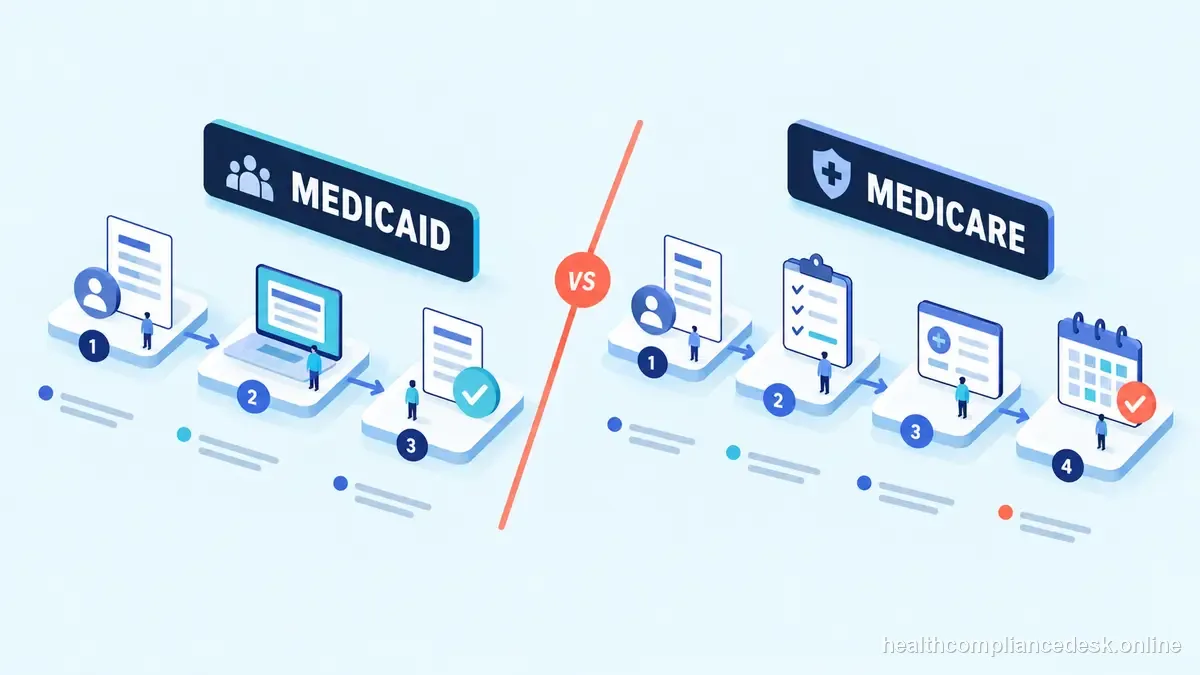
Medicaid vs Medicare Enrollment: Why the Workflows Are Different often starts as a filing request, but the compliance exposure starts when acting on the wrong status. This page concentrates on the records, decision points, and evidence that let practice managers and provider-enrollment staff determine what the file proves and what it does not yet prove.
Operations case: Medicaid versus Medicare enrollment
A vendor reports an application as submitted and the provider group closes the ticket. Weeks later, a development request is unanswered. For this medicaid medicare issue, status reporting should distinguish submitted, development requested, response sent, approved, and effective so follow-up cannot disappear inside one “pending” label.
track development requests and status
Medicare is a federal program administered through CMS and MAC processes; Medicaid enrollment is state-specific even when federal standards influence it. Protect portal ownership and access. In a medicaid medicare review, use practice-controlled accounts and documented authorized officials or delegates where the system allows it; do not let a departing employee or vendor become the only person able to see a critical enrollment record. ## Effective date is an operational milestone A filed application may still be incomplete because of a development request, missing supporting document, signature issue, or inconsistent organizational data. In a medicaid medicare review, track the requested correction and deadline instead of leaving the overall task as simply “pending.”
Close the file with evidence before the next step
Keep the application snapshot, NPI and license evidence, ownership or authorized-official documents where required, submission receipt, development requests, responses, approval letter, participation effective date, and any reassignment or group-link confirmation. Those records support both billing and later revalidation.
Name the Medicare transaction first in the working file
When handling medicaid medicare, medicare enrollment and Medicaid enrollment are not one workflow. For this medicaid medicare issue, medicare uses CMS/PECOS and Medicare Administrative Contractors, while Medicaid enrollment is administered by states. For the medicaid medicare file, a practice should maintain separate checklists and source links.
Identity and authority before PECOS
Before changing a payer or Medicare enrollment, line up the source documents with NPPES, PECOS where applicable, CAQH, and the payer’s existing record. In a medicaid medicare review, mark mismatches instead of copying one system into another without deciding which source is authoritative for that field.
Build the application packet for this scenario
Name the transaction before opening a portal. For this medicaid medicare issue, gather the exact documents and data for that action, reconcile identifiers and addresses, submit through the controlling system, and record the tracking number. Monitor development requests or returned applications until the closing status is issued.
System boundaries
- Use NPPES for NPI identity data, PECOS/CMS and the MAC for Medicare enrollment, CAQH for shared provider data, and the payer for its own participation status.
- Do not assume an update in one system propagates automatically to the others. - When two systems disagree, identify which record is authoritative for the disputed field before editing either one. - Schedule coordinated updates after address, ownership, license, malpractice, roster, or practice-location changes. - Keep access under practice control so a departing employee or vendor is not the only person who can reach a critical account.
| Medicare | Medicaid | |
|---|---|---|
| Administration | Federal program through CMS and MAC processes | State-administered programs |
| Workflow | PECOS and Medicare enrollment path | Portals, provider types, screening, and rules may differ by state |
| Multi-jurisdiction work | Use Medicare path for its transaction | Maintain separate state Medicaid playbooks and status for each state |
Medicaid enrollment must be researched state by state
Medicare uses a federal enrollment framework through CMS, PECOS, and Medicare Administrative Contractors. Medicaid programs are administered by states, which means portals, provider types, screening, managed-care relationships, and revalidation rules can differ. A practice entering several states should build separate Medicaid playbooks rather than cloning the Medicare checklist. The provider’s NPI and common credentialing data can be reused, but that does not make the applications interchangeable. Track each state Medicaid enrollment and each managed-care contract or roster as its own status.
Where Medicaid versus Medicare enrollment needs human review
For the medicaid medicare file, begin with CMS — Medicare Provider & Supplier Enrollment, CMS — PECOS. When handling medicaid medicare, re-check the current CMS, NPPES, CAQH, MAC, or payer instructions that control the transaction because enrollment systems and program procedures change. In a medicaid medicare review, internal trackers and vendor dashboards should point back to the authoritative status rather than replace it.
A common NPI or credentialing record may be reused, but each Medicare, state Medicaid, managed-care, and payer milestone has its own status.
Status ladder for Medicaid versus Medicare enrollment
For this medicaid medicare issue, replace one “pending” status with a short ladder such as submitted, development requested, response sent, approved, effective, and closed. Medicare is a federal program administered through CMS and MAC processes; Medicaid enrollment is state-specific even when federal standards influence it. In a medicaid medicare review, put an owner and next-action date beside every open milestone. A vendor report can summarize the work, but the provider group should retain the underlying CMS/MAC, NPPES, CAQH, or payer evidence so the record survives a vendor change and billing knows exactly what remains unresolved.
Reconcile the source systems
Make a field-by-field crosswalk before editing records. Compare NPPES, PECOS or the MAC record, CAQH where relevant, the payer application, licenses, tax documents, and the organization’s own roster. Medicare is a federal program administered through CMS and MAC processes; Medicaid enrollment is state-specific even when federal standards influence it. In a medicaid medicare review, when values disagree, decide which system is authoritative for that field and correct the source first. When handling medicaid medicare, this avoids the common mistake of copying a stale payer value into a national identifier record merely to make two screens match.
Verification path for Medicaid versus Medicare enrollment
For this medicaid medicare issue, finish on the status that matters operationally: the correct identity record, accepted enrollment or payer action, documented payer effective date, and evidence that downstream billing or roster work is ready. When handling medicaid medicare, “Submitted” or “credentialed” is not a substitute for that final state.
Primary-source review before closing Medicaid versus Medicare enrollment
When handling medicaid medicare, use CMS — Medicare Provider & Supplier Enrollment, CMS — PECOS for the part of the workflow each source actually controls. Reconcile the exact PECOS transaction, NPI, legal and tax identity, evidence packet, MAC correspondence, and final Medicare status instead of treating a vendor tracker as the source of truth. For this medicaid medicare issue, for Medicare work, submission in PECOS is a milestone rather than final approval; for NPI work, enumeration is identity rather than credentialing; and for CAQH, an attested profile is data shared with participating plans rather than a universal payer approval.
Close the loop on the evidence — Medicaid versus Medicare enrollment
In a medicaid medicare review, pECOS submission is not the same as Medicare approval or billing readiness. Check the exact PECOS transaction, NPI, legal and tax identity, evidence packet, MAC correspondence, and final Medicare status, respond to any development request, and close only when the final program status and effective date are documented for operations.