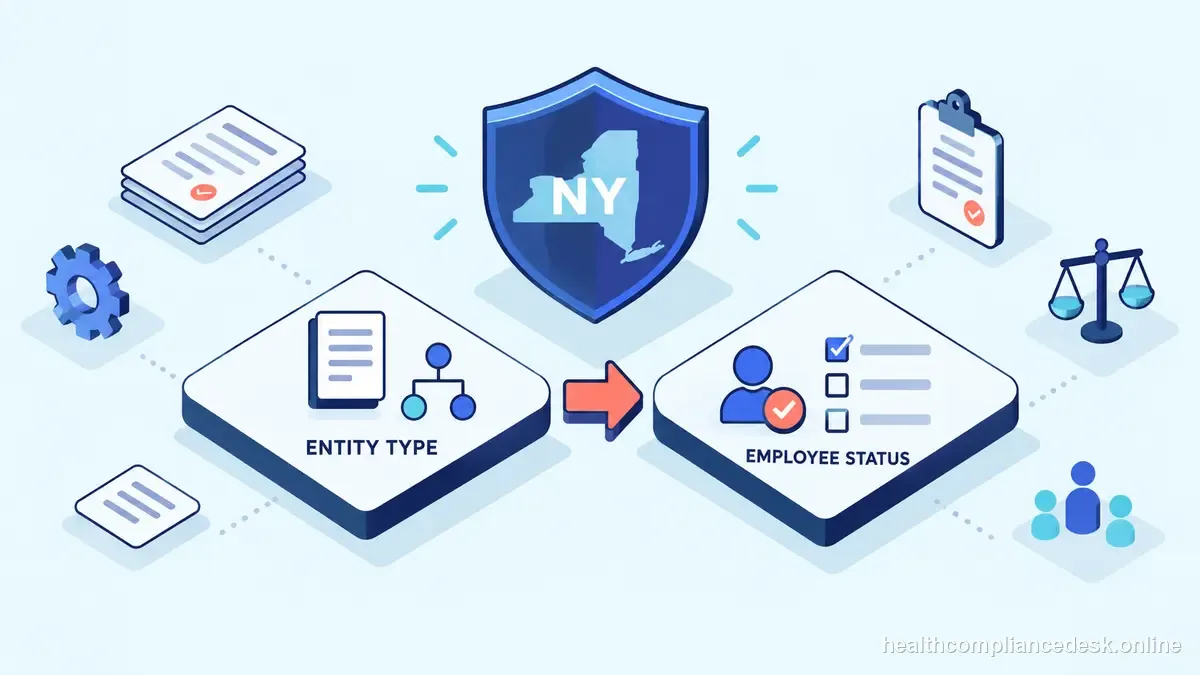
New York’s CE-200 is a narrowly scoped attestation for qualifying government transactions. It does not act as a general owner opt-out, a private-contract certificate, or a response to a penalty notice.
New York CE-200: a permit certificate is not a general owner opt-out
New York search results often label CE-200 an “owner exemption,” which can lead a business to treat it as a universal waiver. The Workers’ Compensation Board describes a narrower purpose: CE-200 attests to a government entity that an applicant seeking a license, permit, or contract is not required to carry New York workers’ compensation and/or disability and Paid Family Leave coverage. It cannot be used to answer the Board about a period of noncompliance or a penalty, and it cannot be presented to a private business or that business’s insurer as proof that coverage is unnecessary.
The Board identifies two categories eligible to request a CE-200 for this government transaction: entities operating in New York with no employees, and out-of-state entities seeking a contract or license where all work is performed outside New York. Out-of-state employers with employees working in New York may need New York-specific coverage. The precise facts matter: employees, leased or borrowed workers, temporary staff, and subcontractors should not be ignored simply because the entity has one owner or issues 1099s. Review the Board’s coverage and worker-classification guidance when any person’s status is uncertain.
The certificate is linked to the specific license, permit, or contract. A building permit certificate is job-specific, so a business should not reuse a prior project’s certificate for a different property. The certificate carries a unique number that the issuing government official can validate. Before requesting it, capture the agency, transaction type, project location, entity name, FEIN, workforce facts, and requested proof; then confirm the output identifies the same permit or contract.
Keep separate records for three questions: whether the employer must carry a policy, whether a particular owner may be excluded from an existing policy, and whether a government application accepts CE-200 as proof of no coverage requirement. Those questions use different rules and documents. If a private customer wants an insurance certificate, ask whether it will accept a policy endorsement or another document; CE-200 is not a substitute. If a penalty or noncompliance notice has arrived, follow the Board’s penalty-response process instead of filing CE-200 to try to clear it.
Before submitting or accepting a CE-200
- Confirm the requesting party is a government entity issuing a license, permit, or contract.
- Verify that the entity and employee facts fit an eligible category under current WCB guidance.
- Use the exact transaction and project information; do not recycle a job-specific certificate.
- Validate the certificate number and keep the issued record with the permit file.
- For private contracts, penalties, owner policy exclusions, or uncertain worker classification, use the separate applicable process.
New York documents that owners commonly confuse
CE-200, an insurance certificate, and an owner exclusion on a policy answer different questions. CE-200 is an attestation used for a qualifying government license, permit, or contract when the applicant is not required to carry the specified New York coverage. It is issued for that transaction and can be verified by its certificate number. A policy certificate or Board-approved proof of coverage addresses an insurance policy. An owner exclusion or policy election addresses the owner’s treatment under the policy and is handled through the insurer and applicable policy forms.
If a private property manager asks for proof, do not send CE-200 as a substitute for insurance. The Board says the form cannot be used to show another business or its carrier that coverage is not required. Ask whether the contract requires a policy, an owner exclusion, or a government attestation and confirm the named entity and job location. For a building permit, prepare a separate CE-200 for each permit because the certificate is project-specific.
If an employer receives a penalty or noncompliance notice, use the Board’s response channel for that notice. Filing a CE-200 does not resolve the past period or update the Board’s compliance record. Gather the coverage history, payroll facts, entity information, dates of work, and any earlier correspondence before responding. When classification or coverage is uncertain, contact the Board’s Bureau of Compliance rather than treating the phrase “owner-operator” as a status determination.
For out-of-state businesses, the Board’s guidance says a CE-200 may apply only when all work under the permit, license, or contract is performed outside New York and no employees of that business work in the state. A single in-state worksite changes the analysis. Keep project scope and workforce evidence with the certificate request so the attestation stays grounded in the actual transaction.

Verify the certificate and retain the permit-specific evidence
Before relying on CE-200, compare the certificate’s applicant name, business, agency, permit or contract type, location, certificate number, and issue date with the current transaction. Validate the number through the Workers’ Compensation Board’s verification service when available. Save the result with the issued certificate and the agency submission receipt. Do not crop out the permit details when sharing it; those details explain why the certificate was issued.
If a permit is amended, a project moves to another location, or the applicant entity changes, ask the issuing agency whether a new attestation is required. For building permits, the Board specifically says certificates are job-specific. Keep each project’s CE-200 in its own record so staff do not accidentally reuse a certificate from a previous job. If the agency asks for a policy certificate instead, provide the insurer’s current proof of coverage, not CE-200.
For an internal audit, ask whether anyone worked in New York during the period, whether the business used temporary or borrowed labor, and whether the permit covers only the work described on the attestation. If those facts differ from the application, escalate to the Board or the issuing agency before stating that coverage is not required. A carefully checked certificate supports one government transaction; it does not make future work or changing workforce facts automatically exempt.
The article says part-time, temporary, casual, borrowed, unpaid, and family workers can count as employees; preserve actual workforce facts.
| Need | Correct question | CE-200 fit |
|---|---|---|
| Government permit/license/contract | Does the entity qualify to attest no coverage is required? | May apply in the eligible circumstances; certificate is transaction-specific |
| Private customer asks for insurance | What policy proof or endorsement does the contract require? | Not accepted as proof to another business or its insurer |
| Board penalty/noncompliance notice | How is the period and liability resolved with WCB? | Cannot be used to answer the Board or resolve penalty |
Match the document to the request and the authority that issued it.