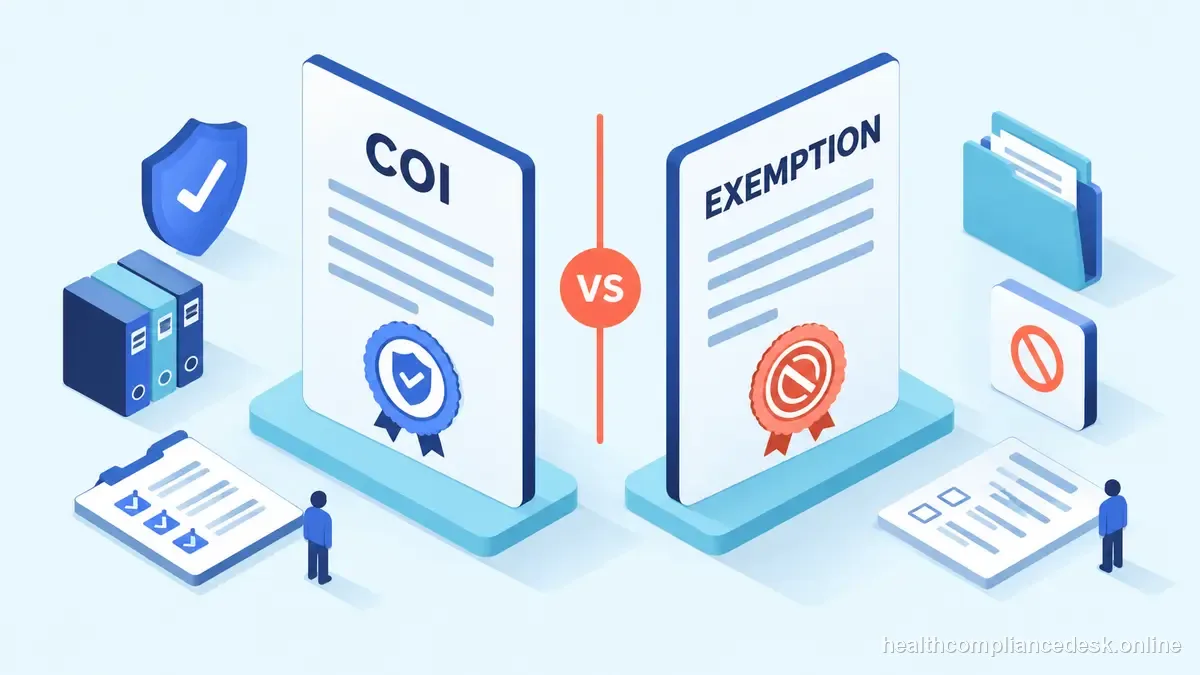
A reliable workflow for Certificate of Insurance vs Workers’ Comp Exemption: They Are Not the Same begins before the portal. Business owners, contractors, and compliance administrators should identify the exact license, worker, provider, entity, or transaction at issue; validate the controlling source; and only then decide what filing or follow-up is required.
renewal and project triggers
A certificate of insurance shows evidence of a policy; an exemption establishes a different status. Neither should be substituted for the other. For the certificate file, assign exception status to any record that cannot be verified, names a different entity, or appears expired. In a certificate review, do not let missing documentation default to “exempt” simply because work is scheduled to start.
Escalate disputed status early
If the agency guidance does not clearly fit the entity or work arrangement, document the facts and ask the state workers’ comp agency, insurer, broker, or qualified counsel a narrow question. Do not import a rule from another state.
Classification before certificates before the next step
Do not treat exemption, exclusion, voluntary non-coverage, and “no employees” as synonyms. A state can use different legal mechanisms for sole proprietors, LLC members, corporate officers, or private employers. The correct mechanism determines what evidence exists and what obligations remain.
certificate of insurance versus exemption in a field file
When handling certificate, an LLC changes members after an exemption was issued. For the certificate file, this coverage question should be reviewed again because ownership and officer/member status can be part of eligibility. Retain the old record for history, but do not use it as proof of recorded status without checking the new entity facts.
What the hiring business should verify in the working file
In a certificate review, when business facts change—new employee, ownership change, different entity, construction work, or a new state—re-run the analysis before the next job. For this certificate issue, a valid status from last year can be irrelevant to the current operation.
A certificate is not a classification test
Classification disputes are a major edge case. A worker labeled “independent contractor” can still be treated as an employee under the applicable statutory workers’ compensation test. Avoid use an exemption certificate or 1099 form to bypass the classification analysis.
Build a contractor evidence file for this scenario
In a certificate review, keep entity records, ownership evidence when eligibility depends on ownership, policy or exemption documents, registry verification, application receipts, renewal dates, and project contracts that impose their own coverage requirements. When handling certificate, for subcontractors, preserve the verification date and the person who performed the check. ## Classification record for this file In a certificate review, describe the work relationship using control, tools, helpers, scheduling, payment, and ability to work for others rather than the tax form alone. In a certificate review, record who directs the work and who bears the practical business risk. In a certificate review, where the state publishes a classification test, apply those factors to the actual facts and retain the analysis. For the certificate file, an exemption for a true owner does not convert unrelated workers into independent contractors. For this certificate issue, revisit classification when the scope or supervision model changes.
| Certificate of insurance | Exemption or exclusion | |
|---|---|---|
| What it represents | Evidence of an insurance policy | A different legal status for an eligible person or entity |
| What to verify | Named insured, policy period, entity, and job | Named person, entity, current agency record, and state eligibility |
| Contract effect | May satisfy a contract insurance clause | Does not replace a policy when the contract requires one |
How a certificate of insurance versus exemption review can unfold
Begin with U.S. Department of Labor — State Workers’ Compensation Officials. Re-check the home jurisdiction workers’ compensation coverage source before relying on an exemption, exclusion, registry entry, or no-coverage conclusion. When handling certificate, insurer certificates and contractor paperwork support the file, but the applicable state rule and live coverage/exemption evidence determine what status is defensible.
Verify the document against the job
A document used for Certificate of Insurance vs Workers’ Comp Exemption is useful only if it matches the present job. Reconcile the named person, legal entity, state, industry or construction context, effective period, and issuing source with the contract and worksite facts. A certificate of insurance shows evidence of a policy; an exemption establishes a different status. Neither should be substituted for the other. In a certificate review, if the file belongs to another entity or expired before the work began, do not treat it as historical proof of compliance. When handling certificate, preserve the mismatch and resolve coverage or eligibility before the next phase of work.
Do not merge legal and contract requirements for certificate of insurance versus exemption
Answer two questions independently. In a certificate review, first, what does the state require for this business, ownership structure, workforce, and industry? When handling certificate, second, what insurance does the customer or prime contractor require under the contract? A certificate of insurance shows evidence of a policy; an exemption establishes a different status. Neither should be substituted for the other. For the certificate file, a valid owner exclusion can satisfy the first question while failing the second. For this certificate issue, keeping those conclusions separate prevents project staff from presenting an exemption certificate as a substitute for a policy the contract expressly requires.
A state-law exemption may address statutory coverage while a client contract still requires a policy. Record both conclusions.
Where certificate of insurance versus exemption needs human review
When handling certificate, tie the conclusion to the present entity, owners, workers, industry, project, and state. A valid owner status can become stale when any of those facts change, so preserve dated evidence and trigger a new review when the employer changes.
Which official record controls certificate of insurance versus exemption
Start with U.S. Department of Labor — State Workers’ Compensation Officials. In a certificate review, verify the worker-classification facts, the legal entity actually performing the work, crew size, and current policy or exemption evidence against the rule and live record that apply on the date work is performed. In a certificate review, a certificate, contract label, or saved exemption PDF is supporting evidence; it is not a substitute for checking whether the person, entity, industry, and project still fit the state mechanism. Preserve the verification date so a later audit can distinguish current status from historical status.
Closeout standard — certificate of insurance versus exemption
For this certificate issue, do not let a 1099, contract label, or owner document answer a classification question it cannot answer. Validate the worker-classification facts, the legal entity actually performing the work, crew size, and current policy or exemption evidence, and re-check the file when the crew, entity, state, or project changes.