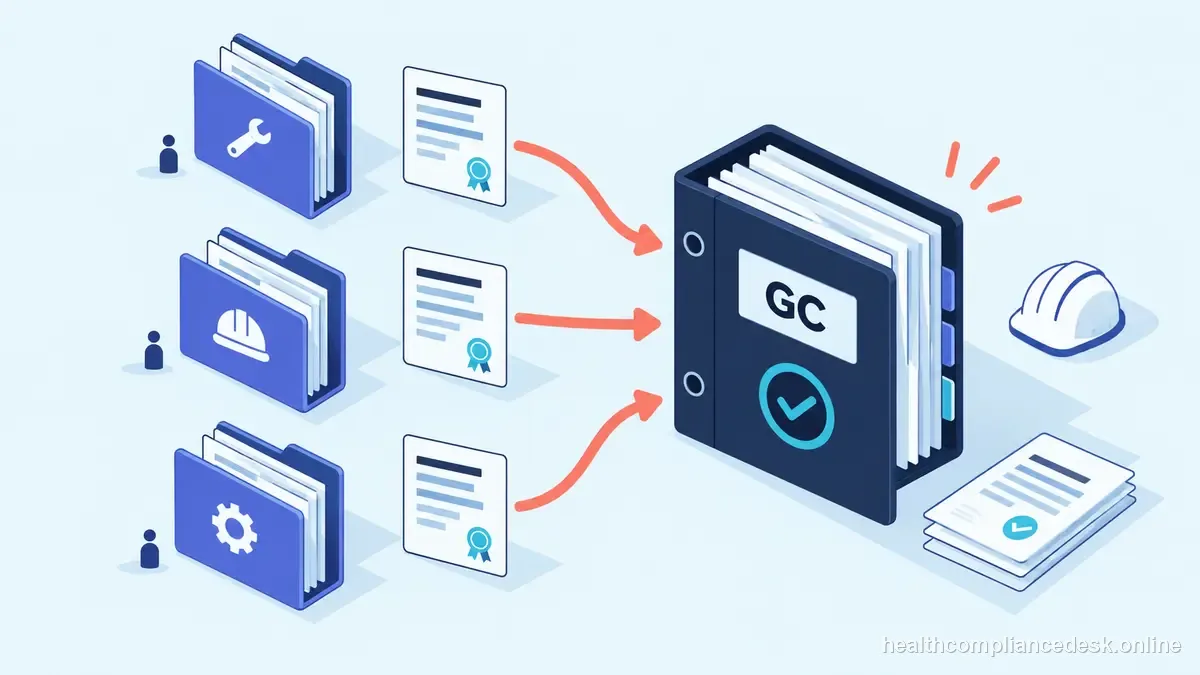
General Contractor Checklist for Subcontractor Workers’ Comp Exemptions often starts as a filing request, but the compliance exposure starts when acting on the wrong status. This page concentrates on the records, decision points, and evidence that let business owners, contractors, and compliance administrators determine what the file proves and what it does not yet prove.
owner status does not cover the crew
General contractors need a verification process for subcontractors because their own premium or statutory exposure can change when a subcontractor lacks valid coverage. Contracts can be stricter than the statutory minimum. A client, general contractor, landlord, or project owner may require workplace injury coverage coverage even when state law would otherwise allow an owner exclusion or no-coverage status.
Bid and contract requirements
For the general contractor subcontractor file, for contractor onboarding, match the policy or exemption evidence to the legal entity and project state, check effective and expiration dates, and confirm whether a crew will perform work. In a general contractor subcontractor review, if the document covers only a named owner, do not extend it to other workers without a legal basis.
Certificates, registries, and expirations before the next step
For the general contractor subcontractor file, keep entity records, ownership evidence when eligibility depends on ownership, policy or exemption documents, registry verification, application receipts, renewal dates, and project contracts that impose their own coverage requirements. In a general contractor subcontractor review, for subcontractors, preserve the verification date and the person who performed the check.
GC and subcontractor coverage in a field file
When handling general contractor subcontractor, an LLC changes members after an exemption was issued. For this general contractor subcontractor issue, this coverage question should be reviewed again because ownership and officer/member status can be part of eligibility. Archive the old record for history, but never simply use it as proof of recorded status without checking the new entity facts.
Cross-state jobs reset the analysis in the working file
For the general contractor subcontractor file, assign exception status to any record that cannot be verified, names a different entity, or appears expired. Never simply let missing documentation default to “exempt” simply because work is scheduled to start.
Construction deserves its own review
In a general contractor subcontractor review, a certificate of insurance proves evidence of a policy; an owner exemption or exclusion addresses a person’s treatment; a contractor agreement or Form 1099 addresses neither by itself. Preserve these documents in separate fields so one is not used as a substitute for another.
Trace every entity on the job for this scenario
In a general contractor subcontractor review, put the legal entity, state of work, industry, owners or officers, ownership percentages where relevant, employee count, and who will actually perform labor on one page. For this general contractor subcontractor issue, add the current policy, exemption, exclusion, registry, or no-coverage basis. For this general contractor subcontractor issue, workers’ comp status is fact-dependent, so the file has to show the facts that support it.
Certificate control — practical closeout
- When handling general contractor subcontractor, capture the named insured or exempt person, entity, issuing source, effective date, and expiration date from every document. 2. For this general contractor subcontractor issue, compare those details with the contract and the people actually appearing on site. 3. For this general contractor subcontractor issue, flag documents that belong to another entity, another owner, or an expired period. 4. For this general contractor subcontractor issue, archive superseded records so an audit can reconstruct what was valid during earlier work. 5. For the general contractor subcontractor file, use a renewal trigger instead of relying on the contractor to send a replacement automatically.
Proving the current GC and subcontractor coverage status
Begin with U.S. Department of Labor — State Workers’ Compensation Officials. In a general contractor subcontractor review, re-check the current state workers’ compensation coverage source before relying on an exemption, exclusion, registry entry, or no-coverage conclusion. For the general contractor subcontractor file, insurer certificates and contractor paperwork support the file, but the applicable state rule and live coverage/exemption evidence determine what status is defensible. For a deeper walkthrough of workers' comp exemption filing by state, see: {{BACKLINK_4}}
Reconstruct the actual workforce
Before relying on the exemption review, write down who will actually perform labor: owners, officers, employees, relatives, helpers, independent contractors, and lower-tier subcontractors. General contractors need a verification process for subcontractors because their own premium or statutory exposure can change when a subcontractor lacks valid coverage. For this general contractor subcontractor issue, then match each person to the entity and status document that supposedly covers or excludes them. This catches the common situation where an owner has valid paperwork but the company also sends workers who are not covered by that owner’s status. For this general contractor subcontractor issue, the workforce snapshot should be dated because staffing can change faster than the certificate file.
Do not merge legal and contract requirements for GC and subcontractor coverage
Answer two questions independently. In a general contractor subcontractor review, first, what does the state require for this business, ownership structure, workforce, and industry? In a general contractor subcontractor review, second, what insurance does the customer or prime contractor require under the contract? General contractors need a verification process for subcontractors because their own premium or statutory exposure can change when a subcontractor lacks valid coverage. For this general contractor subcontractor issue, a valid owner exclusion can satisfy the first question while failing the second. For this general contractor subcontractor issue, keeping those conclusions separate prevents project staff from presenting an exemption certificate as a substitute for a policy the contract expressly requires.
Match owners, employees, helpers, independent contractors, and lower-tier subcontractors to the entity and status evidence for the job.
What operations should verify for GC and subcontractor coverage
In a general contractor subcontractor review, tie the conclusion to the present entity, owners, workers, industry, project, and state. A valid owner status can become stale when any of those facts change, so preserve dated evidence and trigger a new review when the company changes.
Official references to check for GC and subcontractor coverage
Start with U.S. Department of Labor — State Workers’ Compensation Officials. When handling general contractor subcontractor, verify the worker-classification facts, the legal entity actually performing the work, crew size, and current policy or exemption evidence against the rule and live record that apply on the date work is performed. When handling general contractor subcontractor, a certificate, contract label, or saved exemption PDF is supporting evidence; it is not a substitute for checking whether the person, entity, industry, and project still fit the state mechanism. Retain the verification date so a later audit can distinguish current status from historical status.
Closeout test for GC and subcontractor coverage
Never simply let a 1099, contract label, or owner document answer a classification question it cannot answer. Validate the worker-classification facts, the legal entity actually performing the work, crew size, and current policy or exemption evidence, and re-check the file when the crew, entity, state, or project changes.