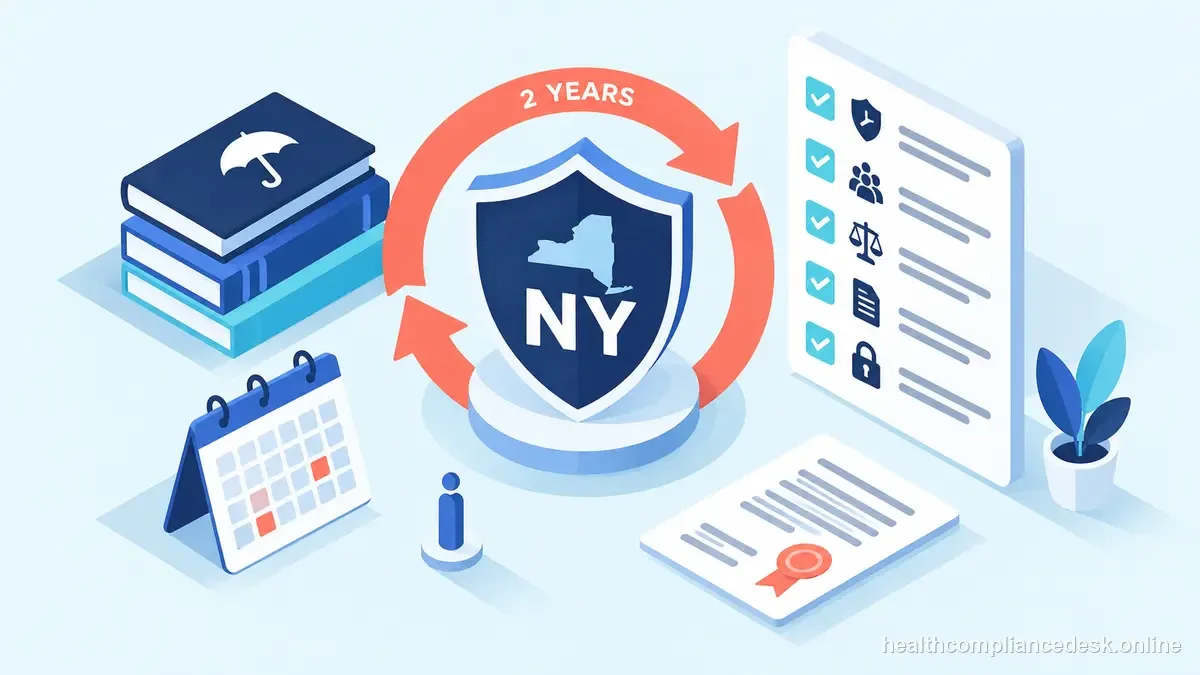
For New York insurance producers, New York Insurance CE Requirements: Biennial Credits and Mandatory Topics is easiest to manage when the evidence file mirrors the real decision. Start with the governing record, separate requirements that are often confused with each other, and do not close the task until the closing status can be verified.
Decision points before you submit
New York DFS’s current CE program criteria state that specified licensees complete 15 credits during each full biennial licensing period, with mandatory subject areas that include insurance law, ethics and professionalism, diversity/inclusion/elimination of bias, and flood insurance for certain property/casualty licensees. Build the renewal task from the licensing record: identify the missing CE, select approved education, complete it early enough for reporting, reconcile the transcript, then file renewal through the accepted channel. When handling new york, capture the filing receipt and confirm that the license returns to the intended active status. ## When to stop and ask the regulator before the next step For this new york issue, a routine CE administrator should not make an unsupported legal conclusion about selling authority. When handling new york, when the answer turns on a disputed interpretation, disciplinary history, or an unusual transition rule, use the state’s licensing unit or qualified counsel. ## What the license record actually tells you in the working file In a new york review, start with the live producer record rather than a saved PDF license. Cross-check the state license status, active authorities, CE cycle, and any deficiency shown on the regulator or recognized licensing system. When handling new york, if an internal tracker disagrees, preserve the discrepancy until the state record is reconciled.
Scenario for New York insurance CE
A New York producer opens the renewal file and finds that internal records and the live state transcript do not agree. Reconcile the state’s current CE requirement, the approved-course data, the completion certificates, and the regulator transcript. For this new york issue, resolve whether the problem is missing hours, a mandatory category, or delayed reporting before purchasing more coursework or filing the renewal.
Before choosing a course
In a new york review, before enrollment, confirm that the state recognizes the provider, the individual course, the number and category of credits, and the delivery method. When handling new york, a national vendor can offer both approved and non-applicable courses, so approval has to be checked at the course level. After completion, compare the certificate with the regulator transcript. ## Where multi-line producers get tripped up for this scenario For the new york file, saved renewal notices and old CE charts become risky after rule changes. If the cycle spans a regulatory update, cross-check the live state guidance with the license holder’s transcript and course dates. When handling new york, transition rules can apply differently from the standard cycle.
a renewal file that can be audited
When handling new york, a defensible CE file shows the chain from requirement to accepted credit. For this new york issue, store the regulator rule or guidance, the approved-course details, completion proof, posted transcript, and renewal confirmation together. Vendor receipts are useful but avoid replace the state’s final licensing record. ## Exception file for this file For the new york file, create a separate note for any residence move, inactive license, late posting, prior deficiency, or specialty-product issue. In a new york review, write down which regulator instruction controls the exception and the date that instruction was checked. When handling new york, avoid combining a late-renewal or reinstatement problem with the ordinary renewal workflow. For the new york file, if selling authority during a gap is uncertain, route that question to the regulator or qualified counsel instead of guessing. In a new york review, retain the resolution and final license status with the cycle record.
New York’s mandatory subject mix makes category review essential
New York DFS states that specified licensees complete 15 CE credits during each full biennial licensing period and identifies mandatory subject areas including insurance law, ethics and professionalism, and diversity, inclusion, and elimination of bias; certain property/casualty licensees also have flood instruction. A producer can therefore have enough total credits and still be noncompliant if the required categories are missing. Use the current DFS requirements and transcript to map credits by subject, not just by total. This is especially important for multi-line producers whose flood requirement depends on the authority held.
Operational check: New York insurance CE
Begin with New York DFS — Continuing Education Provider Program Criteria. Re-check the linked regulator or licensing source for the license holder’s current renewal cycle because CE totals, mandatory topics, delivery-method rules, and portal procedures can change. In a new york review, commercial CE vendors are useful for course delivery, but the state license record and accepted-credit transcript should control the compliance decision.
| Total credits | Mandatory subjects | |
|---|---|---|
| Cycle | 15 credits in a full biennial period | Map required subject areas separately |
| Subject areas | Total alone does not confirm compliance | Insurance law, ethics, diversity/inclusion/bias; flood for certain P&C |
| Record | Use current DFS criteria and transcript | Check authority and category posting |
What survives staff turnover on New York insurance CE
When handling new york, the durable file is a small evidence set rather than a screenshot dump: the license-status snapshot, the CE transcript for the cycle, approval information for any mandatory course, completion certificates, the renewal receipt, and the final active status. New York DFS’s current CE program criteria state that specified licensees complete 15 credits during each full biennial licensing period, with mandatory subject areas that include insurance law, ethics and professionalism, diversity/inclusion/elimination of bias, and flood insurance for certain property/casualty licensees. In a new york review, when a residence move or line-of-authority change occurs, add the effective date of that change and note which jurisdiction became the resident-state reference. This makes a later audit answerable without reconstructing the license holder’s history from email.
The article notes mandatory categories, including flood for certain property/casualty licensees; confirm the current license-specific rule.
Exception that can change New York insurance CE
Close the renewal file only after the home jurisdiction requirement, accepted CE transcript, renewal transaction, and final license status agree. If one record is still pending or contradictory, retain the task open and resolve that exception before relying on the license holder’s authority.
Source check for New York insurance CE
Start with New York DFS — Continuing Education Provider Program Criteria. Use the regulator-facing source to confirm the New York regulator transcript, the current renewal period, and any state-specific course category that applies. For this new york issue, a CE vendor can supply an approved course and completion record, but the vendor dashboard does not replace the jurisdiction’s license status or accepted-credit transcript. Re-open the official source for the current cycle whenever the license holder changes residence, adds a line of authority, or relies on specialty-product training.
What should be true before this file closes
When handling new york, finish the file on evidence, not on course completion alone. Confirm the New York regulator transcript, the current renewal period, and any state-specific course category that applies, preserve the transaction receipt, and verify the final active license status before the agency relies on the producer’s authority.