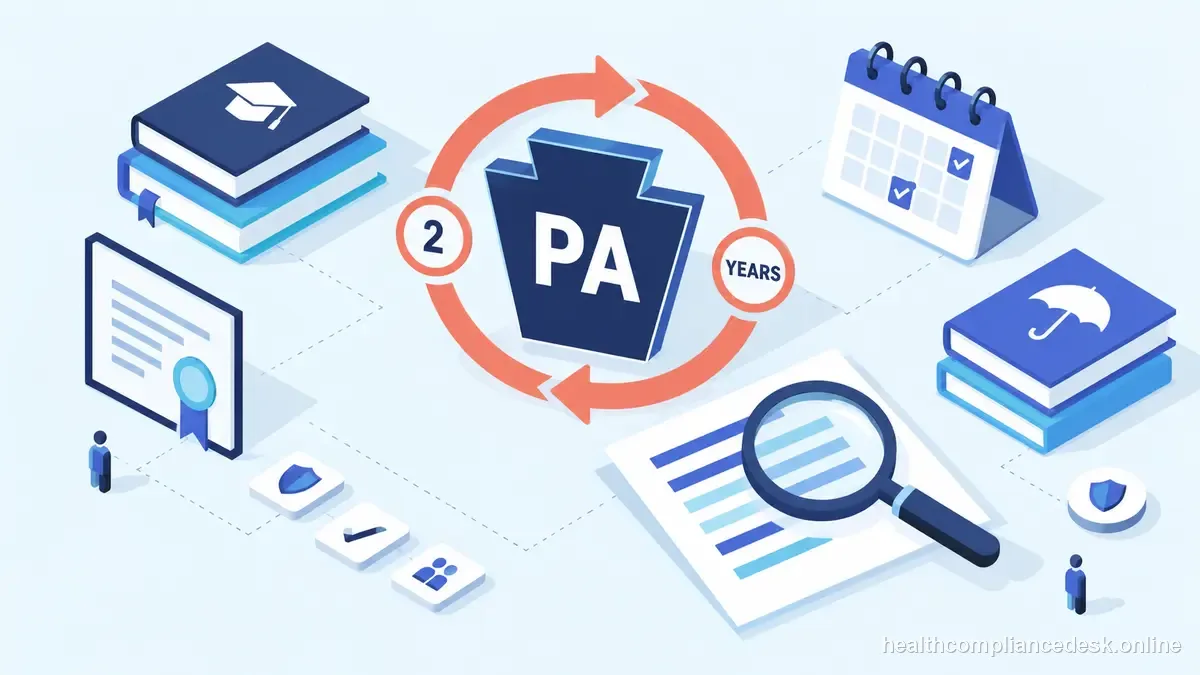
Pennsylvania producer renewal depends on accepted credits in the correct two-year cycle. Use the state’s transcript and renewal record to resolve gaps before submitting the renewal transaction.
Pennsylvania producer CE: use the two-year cycle and accepted transcript
Pennsylvania’s Department of Insurance states that licensed insurance producers must complete at least 24 continuing-education credits during their two-year licensing cycle to maintain the license. The Department warns that failure to complete the minimum results in voluntary termination of the license. That makes the accepted-credit record and the renewal status more useful than a vendor dashboard or a folder of course certificates alone.
Start with the individual’s license record and cycle, then compare each credit against the approved course listing and the Sircon transcript. Confirm that the course and instructor were approved for Pennsylvania, that the credit falls inside the right two-year window, and that the transcript identifies the licensee correctly. If a licensee holds multiple lines or nonresident authorities, check the applicable record rather than assuming that a course accepted for one jurisdiction has automatically posted to every one.
The Pennsylvania DOI points producers to Sircon for individual continuing-education transcripts and approved courses. Use that record to find an actual shortfall before purchasing more classes. If a provider reports completion but the credit is absent, preserve the course title, provider, completion date, certificate, and any course number. Contact the provider or the state’s named processing channel with those identifiers and request a correction; repeat coursework only after you know the first credit cannot be corrected or will not fit the cycle.
Plan the filing around the renewal cycle shown in the license record. Pennsylvania’s individual producer renewal date follows the licensee’s birth month, so a shared agency calendar should contain each person’s actual renewal date rather than one office-wide month. Give the provider time to report credits, check the transcript before submitting the renewal, retain the receipt, and verify the final status. If an unusual circumstance has prevented compliance, the Department says it has limited authority to waive requirements individually, typically for military service or other documented extenuating circumstances. That is an application for a case-specific waiver, not a general grace period.
Pennsylvania CE closeout
- Record the producer’s license number, cycle, and renewal date from the state record.
- Compare the transcript total and course approvals to the 24-credit requirement.
- Resolve missing or misattributed credit with the provider using specific course evidence.
- Submit renewal through the accepted channel and save the transaction confirmation.
- Recheck active status and calendar the next two-year cycle after completion.
Reconcile a Pennsylvania transcript before the renewal transaction
An agency calendar should use each producer’s actual expiration and renewal cycle, not a single date for the whole office. Pennsylvania’s DOI states that the 24-credit requirement applies during a two-year licensing cycle and directs individual licensees to Sircon for transcripts and approved courses. At the beginning of the review, capture the license number, license line, cycle dates, and current accepted-credit total. That creates a baseline against which later provider reports can be compared.
If a class appears on a certificate but not Sircon, confirm that the class was approved and that the provider reported it to the right producer record. Send the provider the course identifier, completion date, license number, and certificate and ask whether the roster was transmitted. If credits are missing because of a wrong identifier, keep the correction request and then recheck the transcript. A screenshot from a course platform proves a user completed the platform activity; it does not prove Pennsylvania posted a credit to the current license period.
When the producer is still short, select a course from the state-approved list that closes the actual deficit. Do not rely on an out-of-state reciprocity assumption or a vendor bundle without checking the Pennsylvania record. If a military deployment or another documented circumstance affected the ability to comply, the DOI describes limited case-by-case waiver authority; preserve the supporting documents and follow the Department’s process rather than assuming a general extension.
After submitting renewal, save the transaction receipt and verify the license status. If the renewal does not complete, identify whether the cause is CE, payment, an application question, or an identity mismatch and route it to the correct support channel. Close the file only after the producer’s active status is visible, then set the next two-year checkpoint and retain the transcript snapshot.

Prevent a Pennsylvania renewal from drifting past its cycle
At the start of each term, download or save the current Sircon transcript and put the renewal date on a shared calendar with an earlier internal target. At the midpoint, review whether the producer is on pace and whether any course has a special subject requirement for the line of authority. Before the final month, stop counting courses from a vendor dashboard and use the state-facing transcript as the balance to resolve.
For a credit dispute, organize the facts as a small evidence packet: producer name and license number, course number and title, approved provider, completion date, exam result, certificate, report date, and the exact transcript line that is missing. Send the packet to the provider or the state contact that controls the issue and preserve the response. If a waiver is requested, keep the supporting military or other documented circumstance and the Department’s decision with the cycle file. A request alone is not proof that the ordinary completion rule has been waived.
After the renewal is filed, check for final active status and correct license lines. If a transaction is rejected, document the reason and next step rather than clearing the calendar reminder. Then create the next cycle with the new expiration date and carry forward only the records that remain relevant. This prevents an expired certificate or a past cycle’s credit total from being mistaken for current compliance. If a producer reports an unusual hardship, keep the supporting record and ask the Department about the applicable waiver process; do not treat a request as an approved waiver. This distinction helps a reviewer see whether the licensee met the ordinary rule or received a specific exception.
The article identifies Department guidance and Sircon access for transcripts and approved courses; a certificate alone is not final acceptance.
- Open cycleRecord license type, cycle dates, and the individual renewal date.
- Complete coursesUse approved courses and keep provider certificates.
- ReconcileCompare accepted credits on Sircon with the 24-credit target.
- RenewFile through the accepted channel and save its receipt.
- VerifyConfirm final active status and calendar the next cycle.
The file is complete only after accepted credit and active license status agree.