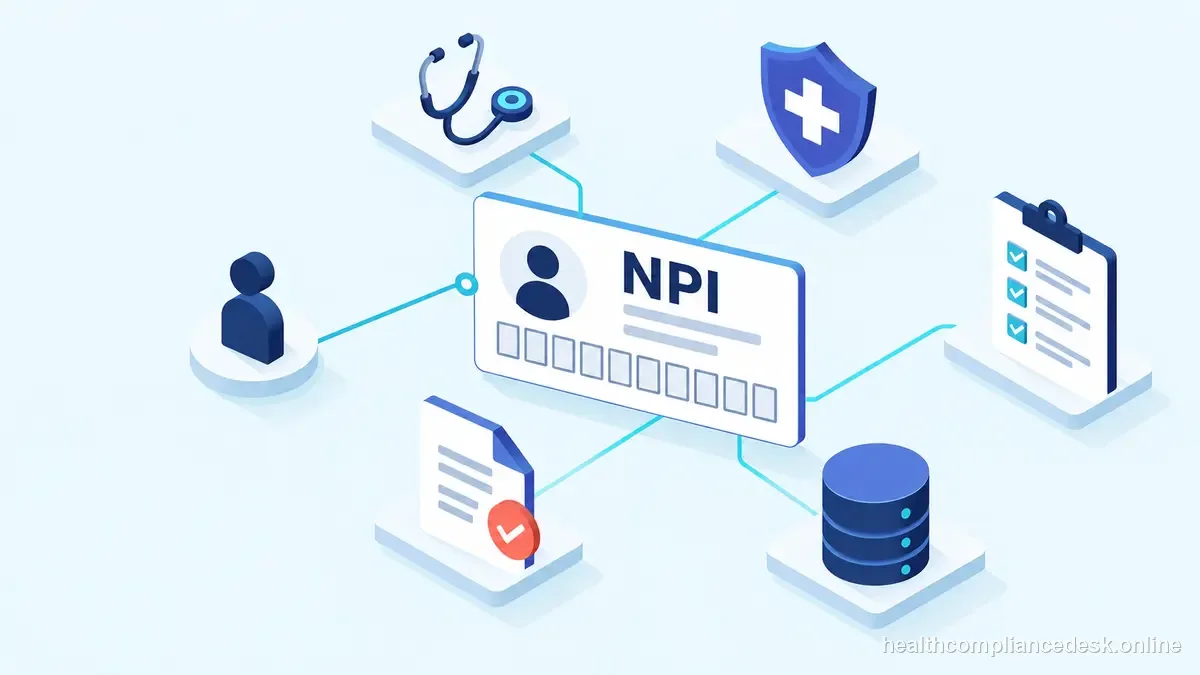
What Is an NPI? A Practical Guide for New Providers often gets treated as a simple admin task, but the practical danger is acting on the wrong status. This article works through the records, decision points, and evidence that let enrollment coordinators and provider-enrollment staff determine which milestone is proven and which remains open.
Reconcile NPPES with enrollment systems in the working file
An NPI identifies a healthcare provider in HIPAA transactions; it is not a license, credentialing approval, or payer contract. Protect portal ownership and access. For this npi issue, use practice-controlled accounts and documented authorized officials or delegates where the system allows it; do not let a departing employee or vendor become the only person able to see a critical enrollment record.
Keep the submission trail
When handling npi, for CAQH work, preserve attestation dates and the documents supporting key profile fields. For payer enrollment, keep the payer’s final status and recognized effective date separately from CAQH or credentialing evidence so billing knows which date controls claims.
| NPI record | Other operational milestones | |
|---|---|---|
| What it establishes | Provider identity in HIPAA transactions | Licensure, credentialing, enrollment, or payer participation |
| Controlling record | NPPES record and NPI type | Separate credentialing, PECOS, payer, and contract records |
| After a data change | Correct authoritative NPPES data first when appropriate | Reconcile affected downstream systems separately |
An NPI is an identifier, not an approval for this scenario
An NPI identifies a provider; credentialing reviews qualifications; enrollment establishes participation or billing setup; contracting establishes network or payment terms; the payer effective date determines when the payer recognizes participation. For the npi file, these milestones can overlap in time but should not share one completion field.
NPI records in day-to-day operations
A provider updates an address in CAQH and assumes every payer and Medicare now has the new location. In this situation, identify which system controls each record, update the authoritative source, and then complete any separate payer or PECOS change transaction that is required.
choose the right record type
In a npi review, use a transaction-specific status rather than “credentialed.” Record whether the task is NPI enumeration, Medicare initial enrollment, revalidation, reassignment, change of information, commercial credentialing, payer enrollment, contracting, or effective-date activation.
Prepare NPPES data before editing
For the npi file, when a provider joins a group, track both the individual’s enrollment and the relationship to the organization. For the npi file, depending on the program or payer, reassignment, roster, tax, contract, or location steps can be separate from the individual’s credentialing approval.
Taxonomy and address changes ripple downstream before the next step
Common enrollment exceptions include different addresses across NPPES and payer files, wrong NPI type, taxonomy mismatch, ownership changes, reassignment errors, a provider moving locations, and a credentialing approval that does not yet have a payer participation effective date. Each should be treated as a reconciliation problem. ## Effective-date handoff for this file Separate credentialing approval from enrollment approval and from the date the payer recognizes for participation or claims. If retroactive billing may be possible, document the payer or program rule instead of assuming it. Tell scheduling and billing which milestone has actually been reached and which remains open. Retain written effective-date evidence with the provider’s enrollment record. Review claims from any gap period before routine billing begins.
State-level wrinkle in NPI records
Begin with CMS — NPI, NPPES. For the npi file, re-check the current CMS, NPPES, CAQH, MAC, or payer instructions that control the transaction because enrollment systems and program procedures change. For the npi file, internal trackers and vendor dashboards should point back to the authoritative status rather than replace it.
Keep credentialing approval, enrollment, contract, roster, and payer effective date distinct; review gap-period claims under the payer or program rule.
Define ready for billing
The operational definition of “done” matters in this enrollment task. When handling npi, submission, credentialing approval, enrollment approval, contract execution, roster loading, and payer effective date are different milestones. An NPI identifies a healthcare provider in HIPAA transactions; it is not a license, credentialing approval, or payer contract. When handling npi, give billing the written effective date and the specific program or payer status rather than a generic “approved” message. For this npi issue, if retroactive billing is in question, document the payer or program rule and route any gap-period claims for review before they are released.
Documents supporting the NPI records submission
For this npi issue, assemble documents because they support fields in the transaction, not because they happen to be available. For the npi file, reconcile legal names, NPI type, tax information, taxonomy, licenses, ownership, locations, and group relationships before submission. An NPI identifies a healthcare provider in HIPAA transactions; it is not a license, credentialing approval, or payer contract. In a npi review, save the exact application snapshot and transaction identifier with any development requests and responses. When handling npi, that packet lets another administrator answer a payer question without rebuilding the application from memory.
Handoff checkpoint: NPI records
In a npi review, finish on the status that matters operationally: the correct identity record, accepted enrollment or payer action, documented participation effective date, and evidence that downstream billing or roster work is ready. When handling npi, “Submitted” or “credentialed” is not a substitute for that final state.
Source check for NPI records
For this npi issue, use CMS — NPI, NPPES for the part of the workflow each source actually controls. In a npi review, reconcile the NPPES record, NPI type, legal name, taxonomy, practice locations, and downstream payer or Medicare data that depends on it instead of treating a vendor tracker as the source of truth. In a npi review, for Medicare work, submission in PECOS is a milestone rather than final approval; for NPI work, enumeration is identity rather than credentialing; and for CAQH, an attested profile is data shared with participating plans rather than a universal payer approval.
Bottom line for the NPI records file
For the npi file, an NPI is an identifier, not proof of licensure, credentialing, Medicare enrollment, or payer participation. Check the NPPES record, NPI type, legal name, taxonomy, practice locations, and downstream payer or Medicare data that depends on it, correct the authoritative NPPES record first when appropriate, and then reconcile downstream systems that never simply update automatically.